


As a storyboard artist I rarely see in scripts or other primary materials, hints of the larger world of the story. I have to ask, not necessarily because I’m going to draw it, but because I’m going into the world of the movie and have to see it unfold in my minds eye, so its good when the director can navigate me through the space. Often the material references are very finite- of only what we see or hear on screen from our characters. Yet a good visual film and similarly in the fine arts they are also influenced by the world that is beyond the frame.
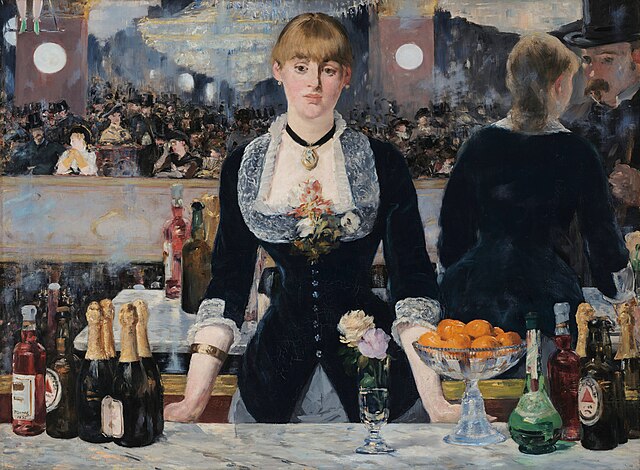
Breaking the fourth wall by looking directly at the viewer is an age old method, the self portraits of Ducreux added an animated expression for impact, the works of French impressionists, in particular Manet, often have a gaze that is breaking free of the surroundings and the distracting splendour of the belle epoque. These were influenced by the advent of photography which captured the outside intrusions and a fleeting glance at the photographer, shockingly breaking the isolation between the subject and viewer. It’s no surprise that in film too we talk of being closer to the eyeline for gravitas, taking us from objective to the subjective.
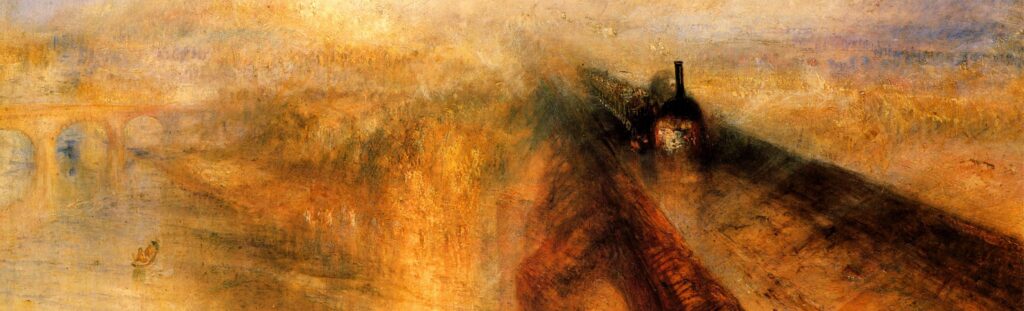
You can look at J. M. W. Turners works – and sense the chaos inflicted by the industrial age on an arcadian England. The important thing is one does not need to know ‘the history’ to understand that these art works fit into a larger world beyond the frame and are not only a vignette but yet somehow also seem to strongly emote the place and time.
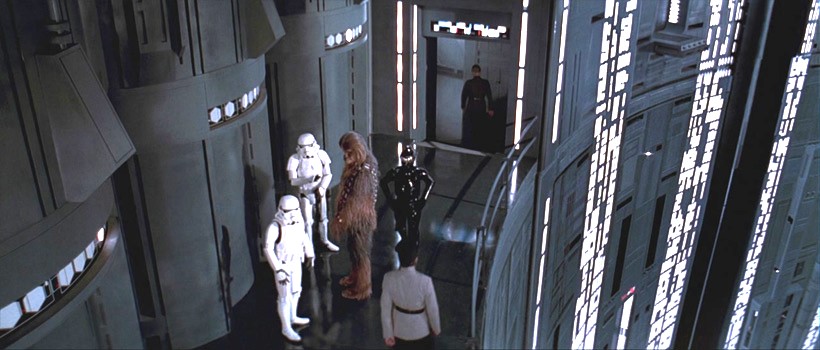
We can create a universe bigger than the subject by manipulating the periphery. In the film Star Wars, throughout the Death Star we see different robots, different coloured uniforms and we are given a sense that there many different jobs on the death star, there are long corridors, doors that we never see open, sound effects of activities off screen, matte paintings of vertical cavernous voids, it’s a well conceived illusion of a much bigger interior of the space station that ‘exists’ beyond the modest edges of the camera frame or a studio soundstage.
In stripping away subjects from their normal environments, an artist may add an element that exists outside of the picture, it might be as simple as a light source- what form does it take? Is it a diffuse light, a harsh light, or artificial light, where does it come from, and what does this say about the subject?
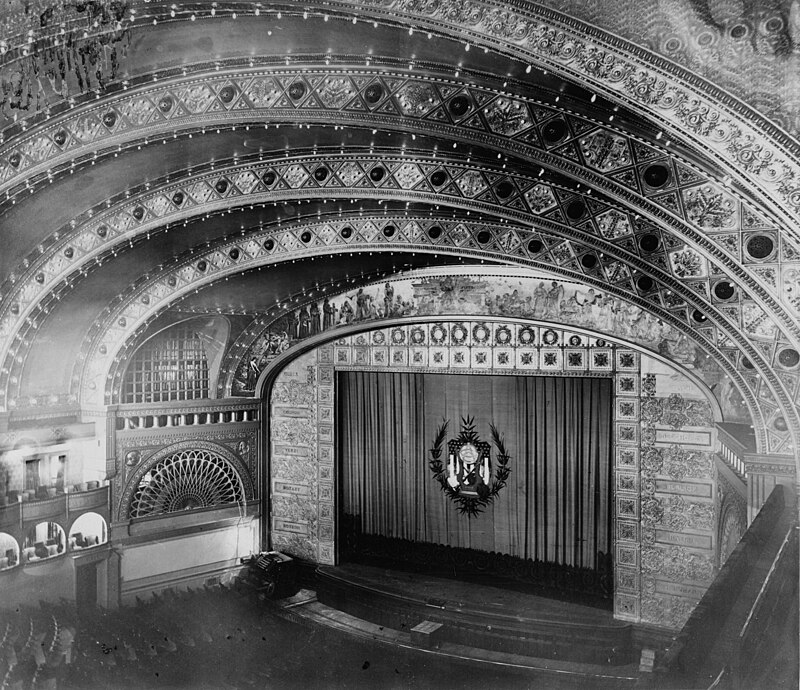
In traditional theatre we have a proscenium arch, a framing device which purposely provides separation of the performance from the viewer. It marks where the art ends and where the audiences’ world begins. Picture frames and tv/cinema screens can perform the same function as a window, the audience is afforded the protection of an observer. To challenge the viewer, the artist may entice them to enter into the artform or the artform can enter the viewers reality. One way is to remove the framing device altogether-say, projecting an image onto an object, using unframed canvas, centring a play within the audience space or using an aside or direct address, the very nature of three dimensional work or sculpture often defies a single privileged viewpoint.
Ceiling frescoes such as Andrea Pozzo’s in the church of Saint Iganzio depicts a breathtaking perspective of the heavens from the earth however in this case the perspective is so precise that by just standing in the wrong spot -stepping out of the frame, the illusion suddenly collapses.
How we feel about the subject is influenced from the outside by the viewers feelings and experiences too, how do we feel about a picture of a luscious bowl of fruit, with a missing bite, if we missed having breakfast? Our own experiences that we bring to the gallery also play a big role in the appreciation of the artform.
The effectiveness of a work is always a conversation the artist is having with the viewer through the subject, the rules of the subject’s world maybe set within the frame but influences beyond the frame stretch wide and far.
In my own work, film or artwork, I am often conscious of a wider context, that exerts some bolder or hinted at reading of the imagery. An influence either planned or discovered can help an a artwork’ break out’ of the shackles of the frame in new directions.
GUNSMOKE